


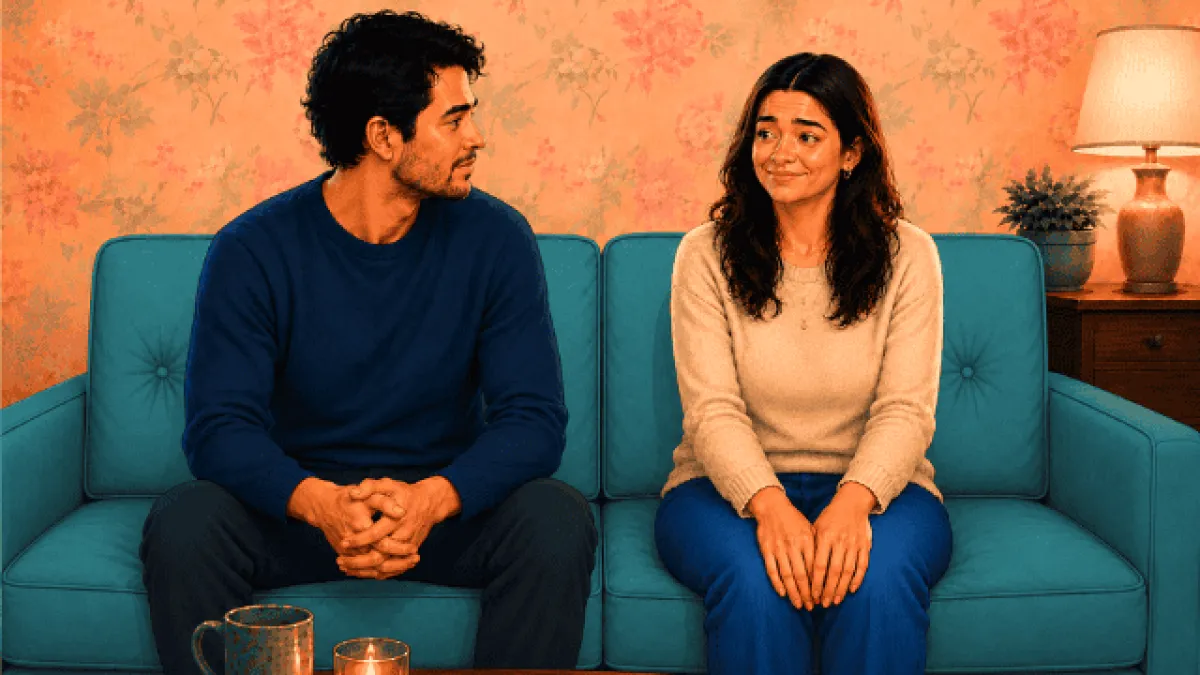
In a therapy session, a woman described how her partner changed their dinner plans last minute. He had suggested going out, she dressed up, but when she arrived, he was tired and wanted to stay home and eat defrosted food. She told him, “I don’t mind—happy to do whatever you want,” and meant it at the time.
Her therapist then asked if her partner’s needs always dictated how things went in the relationship. As she recounted the story, she found herself defending her partner and her own position. Being a therapist herself, she recognized that defensiveness often signals something wrong.
Sitting with herself, she realized the truth was she did not want a defrosted meal that night. She had been a “fawner” for most of her life, though she did not always have that word for it. She thought she was easy-going, flexible, accommodating, and deeply attuned to people.
She always viewed her flexibility as a virtue and her sensitivity as a gift. Those qualities make her effective as a therapist. But underneath them, woven into her personality, were patterns of self-abandonment so subtle and refined over decades that they no longer felt like patterns. They just felt like who she was.
Fawning can be difficult to recognize because it does not feel like trauma. It feels like being thoughtful, accommodating, emotionally intelligent, and deeply attuned to others. People are praised for it. They become the easy one, the loving one, the person who keeps everything harmonious.
It can feel good to be needed in this way. External validation creates a reinforcing loop that keeps a person loved externally. But eventually, the body and relationships begin carrying the cost of everything the personality has learned not to feel.
Larger expressions of the pattern become easier to catch over time. People build awareness and learn to respond differently. But the subtle patterns sneakily become part of identity, built into how a person views themselves and does life. The easy, convincing way she would say, “I don’t mind, you choose,” and believe it and commend herself for it, thinking she was flexible.
Fawning is ultimately about one thing: the terror of disconnection. In intimate relationships, where connection is an anchor of safety, rupture can feel like genuine terror. The fear is that if a person is too much, not enough, or inconveniently themselves, the partner will leave and they will be alone. So they lean in, read the partner’s temperature, and adjust themselves accordingly, giving the partner what they need so the connection holds.
From the outside, fawning looks like consent. But the body is always saying no. For a fawner, a sense of safety lives entirely outside their own body, in the temperature of the other person. They become extraordinarily skilled at reading that temperature, knowing before a word is spoken whether the other person is okay or not, present or absent, open or closed, and they shape themselves accordingly. They are master shapeshifters, constantly asking, “Who do I need to be so that I can keep this safe?”
That question hums beneath the surface of so many interactions, so subtly and for so long, that the fawner stops hearing it and just becomes who they need to be. To bring all that attention to the other person, they have to leave themselves. They override their own body, feelings, instincts, and needs, doing it so automatically that after long enough it no longer registers as a choice. It just becomes them.
Fawning is not a pattern to demonize. It is an intelligent safety strategy, a way for the nervous system to find safety through connection and accommodation when fighting, leaving, or shutting down does not feel possible. The issue is not the response itself, but when it becomes so chronic and embedded that people lose contact with who they actually are beneath it.
The cost of this disconnection always comes. Often with a disconnection from the body. A person cannot unconsciously fawn and also be connected to their physiology at the same time. It also comes with a sense of resentment that builds in the background, without a clear place to pin it because the person was never allowed to have it in the first place.
Maybe the cost shows up in a relationship that feels close but somehow is not, because the person is performing inside it rather than living inside it. Maybe it comes as the persistent sense that people do not really know or understand them. Feeling unseen, unheard, and unvalued is common. Maybe the cost is in health. After decades of suppressing who they are, the body begins screaming with symptoms that can no longer be ignored.
Underneath all the accommodation, there is a part of the fawner that is always waiting. Maybe if they do enough, the partner will finally see them. Maybe if they give the partner what they need, the partner will be who they need them to be. Maybe if they are very, very good, the partner will then be good to them. The hope that someone will finally see them, finally reciprocate, finally show up the way they keep showing up, is what keeps the pattern alive.
For a fawner, hope keeps them waiting for something to finally change. When connection wavers or breaks, when silence or distance shows up between two people, the fawner can suddenly feel adrift. They feel like swimming in open water with no ground beneath them, not knowing what they are feeling, where they are, or what comes next, reaching for something to hold them in place.
In those moments, the mind gets very busy. If the warmth of the connection is suddenly gone, the mind will clutch and reach for anything. Sometimes it goes to fixing. Sometimes to a fantasy of a different life or partner. Sometimes to fault-finding, building a convincing case for why they are better off alone. The same impulse moves through each one: the nervous system reaching for any lever that might restore a sense of control or safety.
It is a beautiful, exhausting illusion. A cognitive loop that keeps a person activated, stressed, and distanced from themselves. What they actually need to feel in those moments is the groundlessness itself. That is the gateway. The unsteady ground is the passage to their own inner ground. To feel the loss of connection, the emptiness and aloneness that arrives in its absence, as something that can be survived, something that does not have to be immediately fixed or fled from. And to discover that in this groundlessness and aloneness, they are not only still here, but they are at home. Something inside them holds strong, even when the external anchor is gone.
It is only from here that anything real becomes possible, including the thing that frightens most fawners more than the disconnection itself.
