


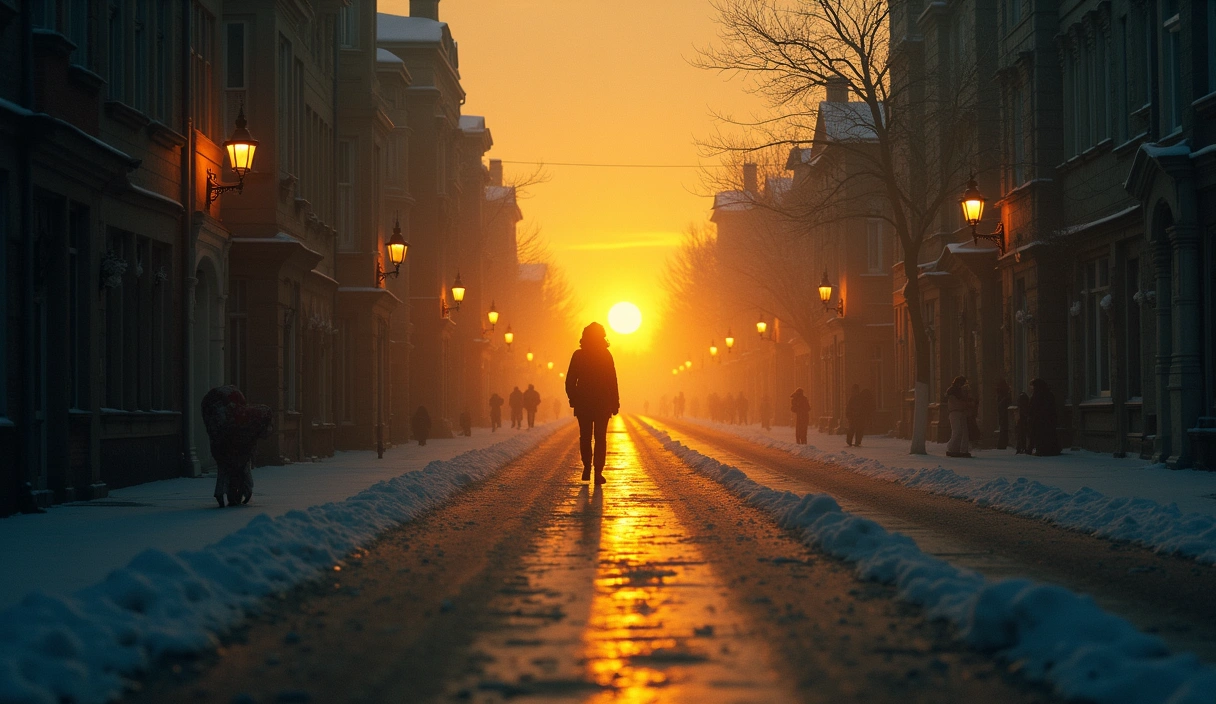
The author recalls a childhood memory of dusk, when the old sodium streetlights would turn on and the world became a yellow monochrome. This moment always made him sad. One evening, his father noticed his quietness and asked why. The author could not explain it. His father then suggested they get ice cream in the village.
The author sat on the back of his father’s bicycle. The yellow world drifted by, and people on the streets had lost their color. They arrived at the shop just before it closed. They stood outside under a lantern. His father held his bike in the snow, eating an ice cream with sprinkles. He asked, “Lekker he?” which means “Delicious, huh?” The author felt his father was saying they were feeling the same thing together.
Staying Light-Hearted
The author is now thirty years old. It has been ten years since his father died of cancer. He says growing up felt like those evenings. The world lost its color over time. He lists broken hearts, bad decisions, and dreams that never happened. Time leaves marks, he says, and nobody escapes it.
The author watched people cope in different ways. Some clung to careers, others turned to partners or gurus. Some became bitter. He tried to stay lighthearted by losing himself in philosophy, art, powerlifting, trading, traveling, filmmaking, and writing. He felt that seeking meaningful answers justified the suffering in life.
One of his art school mentors told him that being a romantic in this world is one of the hardest things to do. He did not understand at the time, but later he did. Even when life was good, the question remained: how to stay light in the heart while carrying the weight of the past.
The more he found, the bleaker the world seemed. The sodium-lamp feeling became constant. The colors did not return in the mornings. He exhausted his known world. Every answer produced a bleaker world. A thought returned, not as a plan, but as an assurance that the door was there if he wanted it.
During that time, he spoke to a woman who was light and full of color. She had a tea box with funny names like Namastea and empatea. She forgot the actual flavors, and they laughed together. They spoke about many things. She always chose the light. She told him he was simply a man who explores as genuinely as he can. She said he should continue exploring, even if it is not convenient.
The author realized he had stopped looking for questions and had only been looking for answers.
The Unknown
The unknown is a child’s friend, the author says, until the child grows up and it becomes an enemy. That hopelessness led him into an abyss. He found he had nothing left to lose. The unknown became the only place that still breathed with life. He went looking for it.
He and his love walked backwards for two months across northern Spain on the Camino de Santiago. They wanted to know what embracing the unknown felt like. At first, they braced for catastrophe because they could not see where they were going. But nothing terrible happened. The unknown stopped feeling like a threat. They felt lighter and freer.
Then they left Amsterdam and moved to the countryside of Panama. They wanted to know what happens in real solitude. In that solitude, the author faced everything he had been outrunning: the unwillingness to accept things as they are, the need to be something in a bleak world, and the desire to make sense of it all.
Finding Your Ice Cream
Through stories from others, the author learned that his father had struggled with existence just as much as he had. He never saw it as a child. On that night with the ice cream, the author thinks his father knew what he was going through. He did not try to fix it or explain it. He just got on his bike and rode to the ice cream shop.
The author thinks about that now. It was not about the ice cream itself. It was the refusal to let the monochrome win. His father did not fight the lanterns or pretend the world was not turning colorless. He just decided that was not a good reason to skip out on vanilla with sprinkles.
Recently, sitting in the sun in Panama with his love, overlooking the Volcán Barú as day turned into night, the author caught himself saying, “Lekker he?” He realized he was living in the same place his father had been all along. Not above the world, not against it, but inside it, enjoying something nice next to someone he loves.
